Ninety minutes a morning, automated. The pharma job-search agent that refuses to apply for you.

An agentic job-search platform for the entire Pharma industry — majors, mid-caps, biotechs, CROs, specialty labs, every functional area. It scans every tier daily, scores against a fit rubric the user helps shape, and emails a single ranked report before first coffee. For strong matches, it goes further. It never submits the application. The human stays in control.

The agent finds and ranks. The human applies. Refusing the last step is what makes it trustworthy enough to leave running every morning.
Join the Pharma beta Book a 30-min call
/ Status   In private beta with one design partner. Pharma-wide SaaS launch with subscription tiers; other industry verticals to follow.
Editorial top-down illustration of a creator's morning desk: laptop open showing a single ranked email with a few schematic role-card blocks, a coffee, a notebook with monospace marks. Restrained, uncluttered.
Ninety minutes of triage, compressed.

The morning loop nobody bills for

Ask anyone in-market for a senior Pharma role how they spend the first ninety minutes of their day and the answer is the same workflow. Open ten or fifteen career-page tabs — one for every tier-one employer in the corridor. Re-run the same search on three or four pharma-specialist boards. Re-run it again on the general aggregators. De-duplicate by hand. Triage by hand. Decide, listing by listing, whether each is worth a deeper look.

The senior Pharma market is small and fast. A relevant listing posted overnight may already have had its first conversation by the time the morning loop reaches it. Speed-to-apply is a real signal, not a vanity one. And the loop itself is unpaid, recurring, mechanical work — the kind of thing that should be a script and instead is somebody's morning.

Generic AI clipping tools and resume optimisers don't fix this. They optimise the application. They don't change the fact that you spent ninety minutes finding it.
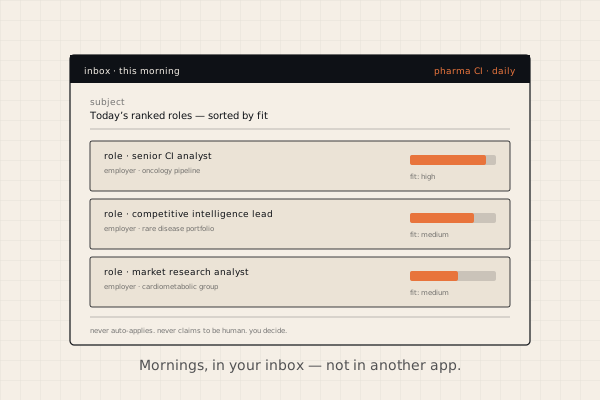
A morning email arriving in the user's inbox before first coffee, ranked into Urgent, Strong and Potential matches, with each listing carrying a deep-dive packet.
The morning email is the artefact.

What it does

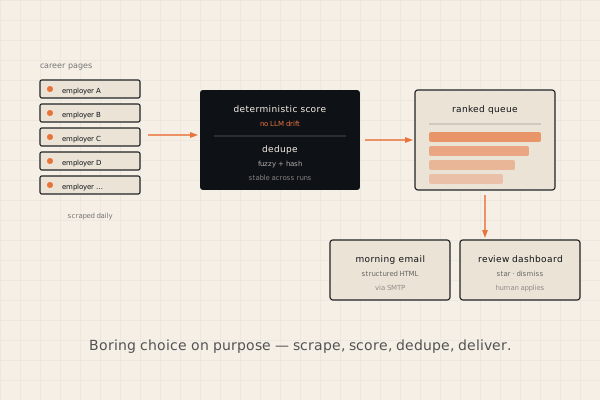
A daily pipeline: scan every Pharma source, parse and standardise listings, score against the fit rubric, deduplicate, and emit a ranked report to the user.
One scan a day. One ranked report. Always before coffee.

Once a day, on a schedule the user sets, the agent fetches every active Pharma source — company career pages, pharma-specialist job boards, the major aggregators, recruiting consultancies. It parses each listing into a standard schema, scores it against the current rubric, deduplicates against everything seen before, and stores what's new. Listings below threshold are filed away. Listings above threshold land in the morning email and on the portal dashboard.

The morning email is the artefact. A single ranked report: an Urgent Match section at the top, then Strong Matches, then Potential Matches, then nothing. Below-threshold listings are excluded entirely — the report is meant to be readable in the time it takes to drink a coffee, not scrolled through. Each entry shows the score, title, company, location, therapeutic area, posting date, source, and a direct apply link. The link goes to the employer. It does not go through the agent.

The portal at the user's desktop is the always-on view of the same data — filterable history, a sources page, run logs, a settings page. Every action the user takes on a listing — Interested, Applied, Rejected, Irrelevant — feeds back into the rubric for tomorrow's run.

The fit-rubric triangle

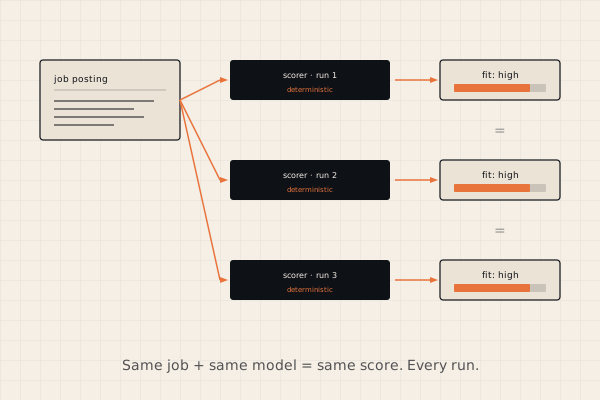
A deterministic scoring step: the same listing scored against the same rubric produces the same score every time. The rubric is the conversation.
Deterministic scoring — the rubric is the conversation.

The fit rubric is the heart of the system, and it's not hand-coded. It's generated as a triangle of three inputs that the user shapes over time.

1. The resume.

The agent extracts prior roles, therapeutic areas, level of seniority, and demonstrated competencies from the user's own resume. The starting profile is the user's actual track record — not a marketing version of it.

2. The aspiration map.

What the user explicitly says they want next. Functional area. Level. Geography. Comp band. Near-term moves vs. exploratory ones. The aspiration map is editable; the user can dial it from safe to growth as their week's mood changes, without re-engineering the rubric.

3. The feedback loop.

Every listing surfaced gets a reaction — relevant, irrelevant, interesting-but-wrong. Those reactions update the rubric. The system gets sharper with use. After a couple of weeks, the user is reading a report shaped by their own taste, not a generic match score.

Scoring itself is deterministic. The same listing scored on the same rubric produces the same score every time. The rubric is the conversation; when the user disagrees with a score, the rubric is what gets adjusted. The model is not the judge.

Above-threshold listings get a deep-dive

For listings the rubric scores as a strong match, the agent stops being a search tool and becomes a research assistant. Five things show up alongside the listing.

Gap analysis.

A side-by-side: what the listing asks for and what the user's profile shows. Explicit on both the matches and the gaps. The user knows before they open the JD whether they're a fit, and where they'd have to position themselves.

Cover-letter draft.

A starting-point cover letter customised to the listing — not a generic template, not a final draft. The user personalises it. The agent saves the blank-page minutes.

Interview-prep questions.

Likely questions for that role + company combination, with prep notes anchored in the user's actual experience. Not LinkedIn-scraped trivia — specific, role-shaped, ready to think against.

Role-and-company research.

A short brief: the team, the company's recent announcements, the likely reason this role exists right now. The kind of context a friend at the company would tell you over coffee.

Application tracking.

Mark a listing Interested or Applied and the agent tracks it. Interview reminders. Status updates. Follow-up nudges. The agent does the bookkeeping. The user does the conversation.

What the agent will not do, on principle, is press the apply button. The Director-level Pharma market is small. A clumsy application is one that gets remembered. The user applies. Always.

Inference runs on the studio's own GPU fleet

The agent's language-model workload — resume parsing, gap analysis, cover-letter drafts, role briefs — runs on the studio's on-prem GPU rig. The same fleet that runs our flagship CBIC tax-research system accelerates the Pharma agent's reasoning. Open-weight models, hardware we own, no per-token meter. Your data never leaves on-prem hardware. The system is unaffected when a frontier vendor changes pricing or deprecates a model on you.

For Pharma candidates, this is the part that matters more than the cost story. Resumes, salary targets, applied-to lists, day-by-day search activity — all of it stays inside the studio's network. There is no third-party model vendor with a copy of your job hunt.

The user's voice

Three things the design-partner user has said about the system. Anonymous on principle — the privacy bar on this product is high.

"It used to take ninety minutes; now it takes ninety seconds."
— the primary user, on the morning loop
"I trust the score because I helped shape the rubric."
— the primary user, on the feedback loop
"I leave it running. I read the email. I apply or I don't."
— the primary user, on autonomy with control

If you're considering a vertical AI agent for your own domain — a daily scrape-and-rank workflow that's currently somebody's morning — the pattern generalises. Book a 30-min call and we'll talk through whether the same shape fits.