
The parent's problem
You're the parent of a kid — or a young adult living at home — who could be learning, isn't, and you both know it. They lock into a competitive game for eight hours and learn frame-perfect inputs, ranking systems, the meta of a community in three time zones. The capacity is there. Sitting in front of a textbook is what isn't.
You've tried the usual fixes. Lectures, online courses, a tutor, an app with badges and streaks. Most last two weeks. The ones that last longer don't move the needle — the kid taps through lessons the way they tap through a chore. The problem isn't intelligence and it isn't content. What's missing is a motivation engine a gamer-shaped brain will actually run.
Why earning works (and badges don't)
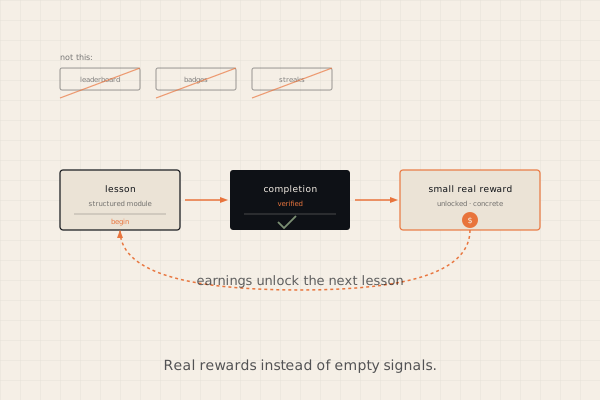
"Gamified learning" borrows the surface of games — XP bars, streaks, mascots, leaderboards — and misses the part that actually keeps a player playing: the feedback is honest. Win a ranked match, you climbed. Clear the chart, you played it. The game doesn't lie about whether you're getting better.
Money is the same kind of honest feedback. When a parent pays you on terms they took seriously, or a stranger pays for something you built, the proof isn't a number on a screen — it's a transaction in the world. EarnLearn uses earning as the spine of motivation for that reason. Every completed lesson moves a real number on the earnings tracker, every module-end milestone unlocks an actual transfer. No leaderboard. No streak the kid will protect at 11pm by tapping through a fake lesson. We pay for the work, and the work is substantial enough that the payment is earned. The reward has to be real.
What it does
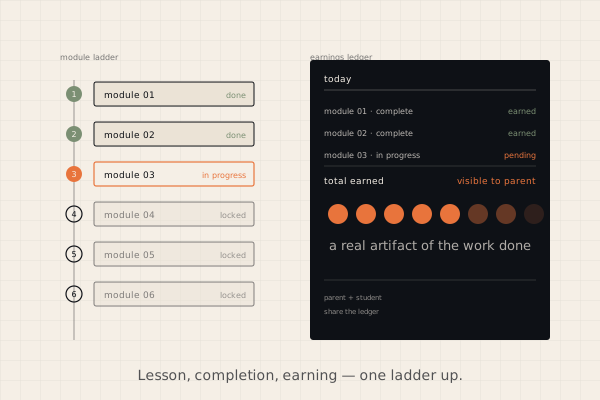
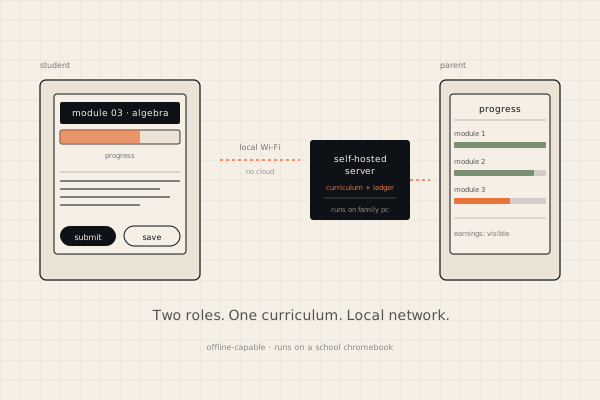
Two accounts: a learner and a parent. The learner sees today's lesson, a journey map of the full curriculum, an earnings tracker, and a community page. The parent's dashboard shows progress, pending sign-off requests, and a settings panel that tunes nearly every parameter without touching code.
Every lesson day is the same four-phase loop. Challenge — a prompt the learner attempts before any teaching. Learn — pick one of three modalities (read, listen to a two-host AI-generated audio version, or read a personalised study guide). Practice — write/draw/voice tasks, one at a time, scored against an inline rubric by the AI tutor. Checkpoint — an auto-graded quiz, then a sign-off request to the parent. Approve, reject with feedback, release the rewards.
The earnings ladder is visible to both sides at all times. AI generates the lesson content, practice rubrics, and quiz items on demand for whatever subject the parent and learner have agreed on. The platform is a renderer; the curriculum is data; the AI is what writes that data.
Subject-agnostic by design
The first subject we built a curriculum for is AI — foundations, Python, files and APIs, web basics, AI fundamentals, and a capstone called Build & Ship: Real Products That Earn. AI is what we know best, so AI is where we proved the engine. But AI is one subject, not the system. The same four-phase loop works for fractions, French verbs, or the causes of the First World War. A parent who wants their twelve-year-old to learn algebra can request it and the engine writes the curriculum. The earning ladder carries across.
Challenge first, teach second.
Every lesson starts with a prompt the learner can't yet answer. They try anyway, get parts wrong, and the wrong parts are exactly what the lesson then fixes. Make the brain want the answer before it gets one.
Rubrics, not vibes.
Every practice task carries an explicit scoring rubric the AI tutor uses to give feedback. The learner can see the rubric before they start, which is also the spec for what "done" looks like.
The parent is in the loop, not on a notification stream.
The parent reviews the day's quiz log and sign-off request once a day, in batch, on their own schedule. Approval releases the reward; rejection sends back specific feedback. Thirty minutes of attention, daily, on the work that matters — not a notification stream and not a weekly digest.
Your child's learning data never leaves your home network
A learner's progress, their answers, their weak spots, the parent's notes about them — none of that has any defensible reason to live on a vendor's server. Enterprise local-first is about compliance; family local-first is about a deeper trust, because the procurement team a company has to push back on a vendor's terms-of-service is the team a family doesn't have.
Today the AI tutor calls a hosted language-model API; we're honest about that. The migration we're shipping next moves the tutor onto our local model rig, so the entire pipeline stays on hardware the family controls. When that lands, the answer to "where does my kid's data go?" is the same as "where is the laptop?"
Where the build is
First-draft platform is implemented and running in dev. Two-account architecture, four-phase lesson loop, reward ledger, earnings page, six modules of curriculum for the first subject, AI tutor wired against the hosted model. The parent review-and-sign-off cycle has been tested by the studio operator playing both sides.
What hasn't happened yet: the first learner has not started. They've said they will. The day they do is the day this page changes from "in build" to something else; we're not pretending that day has already happened. The local-model migration is also pending. This is the studio's stance on "built for one person, before any user research" — family-scale software, built for one person you actually know, is going to matter more in the next five years than another generic SaaS.
How it ships
Two ways. A SaaS subscription, with tiers, for households that want to run it on their own laptop with the standard curriculum library and a configurable reward economy — your kid, your laptop, your terms with them about the money. Or a custom build, for parents or organisations who want EarnLearn shaped to a specific learner, subject, or reward model the standard tiers don't fit. Same engine, bespoke output. Each custom engagement is its own project, with a 30-minute call up front to figure out whether the shape fits.
If you're an organisation thinking about a learning product for a population you actually know — one classroom, one programme, one cohort with a specific shape — the same engine adapts. Book a 30-min call and we can walk through what a custom build would look like.