If you've spent the last two years watching general-purpose AI assistants get steadily more competent, here is a question worth sitting with: why are the people who do regulated work — tax practitioners, doctors, lawyers, auditors — still mostly not using them for the parts of their job that matter?
The lazy answer is "the models will get there." That answer is wrong, and the way it is wrong is instructive. The reason a senior tax practitioner cannot use a general-purpose AI assistant to draft a notice response — even though the model is, by any reasonable measure, smarter than half their juniors — has nothing to do with model quality.
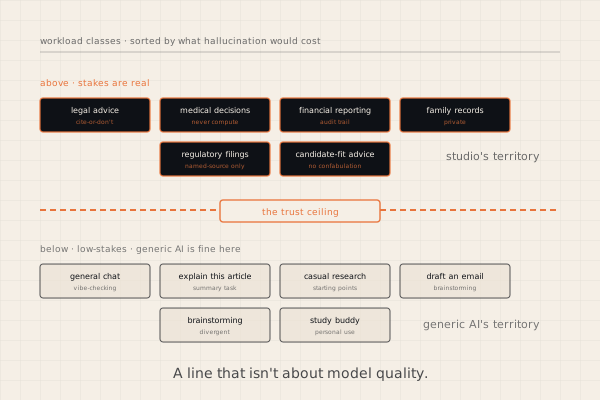
It has to do with what we have started calling the trust ceiling: the line above which a hallucinated answer is not embarrassing, it's career-ending. Below the line, generic AI is fine and getting better. Above it, generic AI cannot be used at all, no matter how good it gets, until the architecture changes.
What the line looks like
Below the trust ceiling: general chat, "explain this article," casual research, drafting an email, brainstorming, vibe-checking an idea. These are workloads where a wrong answer is, at worst, a polite "actually, that's not quite right" from the user. The cost of a hallucination is friction. The user is already in the loop, comparing the model's output against their own knowledge, and a wrong answer is just one more piece of input they were going to evaluate anyway.
Above the trust ceiling: legal advice, medical decisions, financial reporting, family records, regulatory filings, candidate-fit advice for a senior hiring decision. The cost of a hallucination here is not friction. It is, depending on the workload, a malpractice exposure, a misdiagnosis, a fraudulent statement, a privacy violation, an embarrassing recommendation made on a candidate's behalf to a real employer.
This is why a senior tax practitioner can use a general-purpose AI assistant for "draft me an email asking my client for an extension" but not for "review this notice and tell me what section it's invoking and what the right response is." The first is below the line — the answer is just a starting point and the user will rewrite it. The second is above — and a confident wrong citation, dressed in convincing legal vocabulary, is precisely the failure mode the practitioner cannot accept.
The obvious point
AI hallucinations break trust. Anyone who has been embarrassed by a model confidently making up a citation knows this. It is a real, shared experience.
This is not, however, the interesting point. The interesting point is what to do about it, and that's where most of the conversation in our industry has gone wrong.
The subtle point
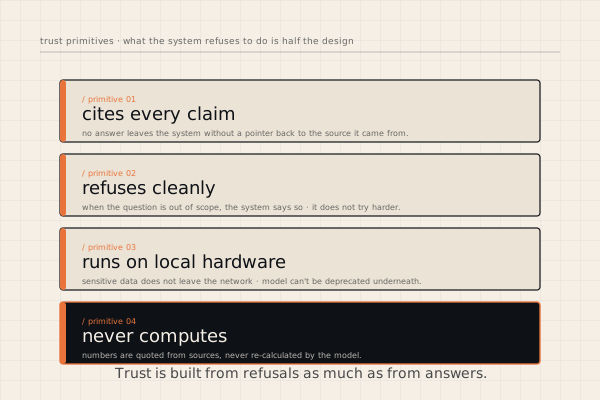
The architecture decisions that get a system above the trust ceiling are mostly not about better prompts, more context, larger models, or more clever fine-tuning. They are about what the system refuses to do, what it cites, what it owns versus what it routes to a human, and what it never computes.
Trust, in other words, is engineered. It is not inherited from the model.
This is unintuitive enough that it deserves a second pass. The mainstream framing of AI quality is "the model is good, therefore the answer is good." That framing has predictive power below the trust ceiling and almost none above it. Above the line, the question isn't "is the answer good," it's "can the user trust the answer enough to take action on it." And trust is built from a different set of properties than model quality.
"The trust ceiling is not a model-quality problem. It is an architecture problem, and the architecture is mostly about refusals."
The four primitives that build trust
Looking across the studio's regulated-work systems — the tax-law retrieval system, the candidate-advice job agent, the personal-archive engine — there are four architectural primitives that show up in all of them. Each of them is a thing the system does on purpose, often at apparent cost to the user experience, because the alternative is a system the user cannot trust.
1. Cites every claim
No answer leaves the system without a pointer back to the source it came from. In the tax system, every paragraph in the answer is a citation to a specific section of a specific notification. In the job agent, every "this candidate is a fit because..." is anchored against a real line in the real CV and a real line in the real job ad. In the archive system, every "this is your father's college transcript" is anchored against the actual file it was extracted from, with confidence shown honestly.
This is more constraining than it sounds. It means the system cannot "synthesise" a piece of evidence it doesn't have. It means the model is not allowed to get creative with sentence structures that imply support it cannot point to. It means the answer, by construction, can be fact-checked in the time it takes to click a citation. The citation is not a feature; it is the structural commitment that the answer is grounded.
2. Refuses cleanly
When the question is genuinely outside the system's competence, the system says so — clearly, briefly, without trying harder. This is the one most teams skip, because refusal feels like failure to a designer. It isn't. It's the most important capability a regulated-work system has.
Above the trust ceiling, the worst possible answer is a confidently-wrong one. The second-worst is a confidently-right-sounding one that you can't tell apart from the wrong one. A clean refusal — "I don't have evidence about this in my corpus; you should check elsewhere" — is, paradoxically, the answer that builds the most trust over time. Users come to know that when the system gives them an answer, it has the receipts; and when it doesn't, it tells them.
Designing this is harder than it sounds, because the model wants to help. Off-the-shelf, an LLM will do its best to answer almost any question, including ones it has no information about. The architectural commitment is to add a step, after retrieval, that asks "is the answer grounded in evidence we actually have?" — and if the answer is no, to refuse rather than to dress up a guess.
3. Runs on local hardware
Sensitive data does not leave the network. The model that does the work runs on hardware the studio (or the client) controls. The model can't be deprecated underneath the system; the data isn't subject to a vendor's evolving privacy policy; the version of the model the auditor reviewed last year is still the version running this year.
This is partly a privacy commitment and partly a stability commitment. Above the trust ceiling, both matter. A medical-decision system that runs through a vendor's API has to be re-validated every time the vendor updates the model. A family-archive system that uploads private letters to a hosted endpoint is a privacy violation by architecture. Local-first isn't an aesthetic — it's the only way to make the trust commitments concrete. We've written about the cost economics of this choice in a separate note; the trust argument is independent of the cost one.
4. Never computes
Numbers are quoted from sources. They are never re-calculated by the model. This sounds obvious; it is in fact the failure mode that has burned more regulated-work AI deployments than any other.
If the question is "what is the interest payable on this notice," the system does not invite the LLM to do arithmetic. The arithmetic is done by code, against a formula in the statute, against the numbers in the notice. The LLM's role is to identify which formula applies and to surface the inputs — but the multiplication and the addition are done by a function that is reproducible, auditable, and not subject to the model's mood. (We've written about the broader principle of determinism at the floor separately.) For regulated work it is not optional.
The same rule applies in subtler ways everywhere else. The job agent does not "estimate" how senior a candidate is — it counts years from structured fields. The archive system does not "guess" a date — it surfaces the metadata or admits it doesn't have it.
Why these primitives are unfashionable
It is worth being honest about why most AI products on the market today don't have these primitives. They are unfashionable for a specific reason: they make the system look less impressive in a demo.
A system that refuses a question makes the user think the AI is dumb. A system that always cites the source makes the user think the AI is just doing search. A system that runs locally is missing the cloud-magic vibe. A system that never computes feels less like AI and more like a calculator with a chatbot strapped on.
All of these reactions are correct, in a sense. The system is dumber than its competitors at impressing strangers. It is, in exchange, smart enough to be used for the kind of work where being wrong has consequences. That's a trade most consumer AI products don't make, because their users don't need it. It is the trade every regulated-work AI product has to make, because their users do.
What this means for buyers
If you are the senior partner of a tax firm, or the operations head of a hospital, or the head of compliance at a financial institution, and a vendor is selling you "AI for X," ask them four questions. The questions correspond to the four primitives.
Does the system always cite the source? If yes, ask to see the citation in a sample answer. Click it. Does it lead you to the actual evidence the answer claims to be from? Does the evidence actually support the claim?
Does the system refuse out-of-scope questions? Ask it a question it shouldn't be able to answer — something far outside its corpus. Does it refuse, or does it try to help?
Where does the model run? Whose servers? What's the data-retention policy? Can the vendor demonstrate that sensitive data does not leave a perimeter you control?
What happens with numerical answers? Are the numbers computed by the model, or by code against a known formula? If the model is computing, it is wrong sometimes, and you cannot tell when.
If the vendor cannot answer those questions cleanly, the system is below the trust ceiling. That is fine for some workloads and disqualifying for others. Knowing which workloads is, frankly, your job. Knowing which architectures match is ours.
The closing argument
The framing we've found most useful, when explaining why a regulated-work AI deployment looks structurally different from a consumer one, is this: the model is the engine; trust is the car around it. The engine matters, but you cannot drive an engine. What gets you on the road is everything that is not the engine — the chassis, the brakes, the seatbelt, the windshield. In an AI system, those are the citations, the refusals, the local hardware, the never-computes. They are the parts that make the engine usable.
The studio's projects above the trust ceiling — the legal-corpus system, the candidate-advice agent, the family-archive engine — all use the same general-purpose AI components every other product uses. The difference is the structural commitments around them. That is the work that is actually being done. The model just sits inside it.
And it is the work, more than anything else, that the AI industry's marketing has been quiet about — because the work isn't what makes the demo impressive. It's what makes the deployment real.
If you're evaluating an AI system for regulated work and you'd like a clear-eyed read on whether the architecture stands up to the workload — that's the kind of conversation our 30-min calls are for. Book one.